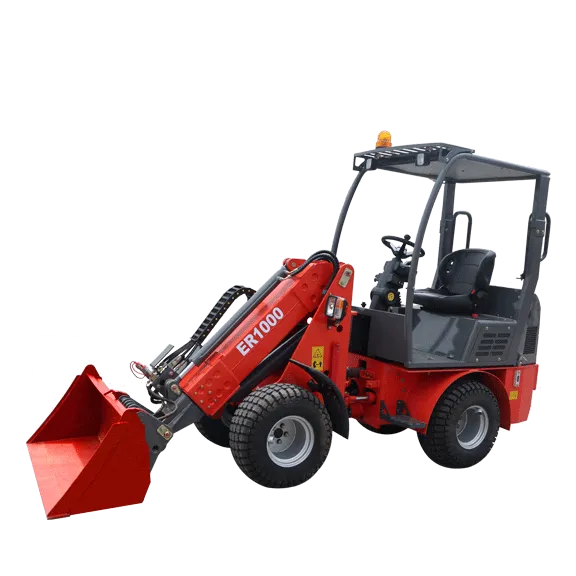
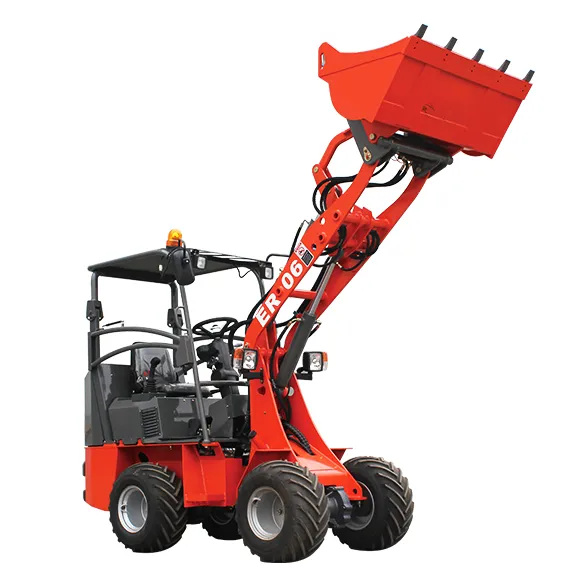
With its flexibility, compact design and versatility, mini telescopic loade has become an ideal choice for modern construction, agriculture, gardening and urban facility management. Compared with traditional loaders, mini telescopic loade can easily handle small spaces and high-altitude operations through telescopic arm technology.
This equipment is not only suitable for various terrains and complex environments, but also can complete various tasks such as handling, cleaning, and excavation by quickly replacing different attachments. Therefore, it has shown great potential in improving work efficiency, saving space and reducing operating costs, and has become a highly favored high-efficiency tool in the industry.
Mini telescopic loade in various applications
Mini telescopic loade has become indispensable equipment in many industries and working environments due to their excellent flexibility, versatility and efficient working capabilities.
Construction sites: efficient operation and space saving
On construction sites, especially in urban construction and intensive construction projects, space is often limited and the working environment is complex. The compact design and telescopic arm technology of the mini telescopic loade enable it to operate flexibly on narrow construction sites. The telescopic arm can be extended to high or deep places to help workers perform high-altitude or deep-well operations, such as moving construction materials, cleaning up garbage, and installing equipment.
Warehousing and logistics: improving warehouse operation efficiency
The mini telescopic loade can operate precisely in narrow warehouse aisles and quickly move materials. Especially in storage environments with limited height, the telescopic arm can provide a larger working height and higher shelf operation capacity.
Urban facility management: an efficient tool for cleaning and maintenance
The high extension capacity of the telescopic arm allows it to easily handle cleaning work in high-rise buildings in cities, such as cleaning high-altitude windows and maintaining municipal facilities.
With its excellent adaptability and efficient operation ability, it has shown great advantages in many fields and working environments. Whether in urban construction sites with limited space, narrow storage and logistics areas, or in agriculture, gardening and urban facility management with high precision requirements, the flexibility, maneuverability and versatility of telescopic arm loaders make them an indispensable and important tool in modern equipment.

Comparison with traditional loaders
Work efficiency
- Traditional loaders: Traditional loaders usually have strong power and large load capacity, suitable for large-scale handling, shoveling and earthwork operations. However, the work efficiency of traditional loaders may be limited in environments with limited space, complex terrain or high-precision operations.
- Mini telescopic loade: Work efficiency is particularly prominent in small spaces and high-altitude operations. Thanks to telescopic arm technology, the equipment can extend the working height and working radius, making operations in complex working conditions such as high-rise buildings, stacking or deep wells more efficient. At the same time, its compact body design allows operations to be completed quickly in narrow areas, improving the overall efficiency of the operation process.
Mobility
- Traditional loaders: Traditional loaders are usually large in size and suitable for open construction sites, but have poor maneuverability in urban construction, narrow roads or dense areas. Due to their large turning radius and long body, traditional loaders lack operational flexibility in narrow environments, which may lead to longer operation time and even require the assistance of other equipment.
- Mini telescopic loade: The machine design focuses on improving maneuverability. Its compact body and small turning radius enable it to maneuver flexibly in narrow spaces, easily navigating city streets, small construction sites or intensive construction environments.
Operation accuracy and versatility
- Traditional loaders: Traditional loaders are suitable for tasks such as bulk material handling and earthwork. They have relatively low operation accuracy and rely more on the operator’s experience and operating skills.
- Minitelescopic loade: Its versatility and high precision make it particularly outstanding in various environments. In addition to basic handling and shoveling functions, it can also perform a variety of operations such as excavation, cleaning, and bulldozing by quickly changing attachments, greatly improving the adaptability and flexibility of the equipment.
Its compact design, the flexibility of its telescopic arm and its wide operating range enable it to demonstrate excellent performance in complex, narrow, high-altitude and other special operating environments. It is particularly suitable for diversified application scenarios such as urban construction, warehousing and logistics, and agricultural gardening.
Safety design and operation specifications
Anti-rollover protection system
Anti-rollover protection is one of the most basic and important safety designs of Mini telescopic loaders.
- Automatic rollover warning system: When the working angle or load of the Mini telescopic loader exceeds the safe range, the system will automatically send out a warning signal to remind the operator to adjust the equipment position or lower the load to avoid rollover.
- Anti-rollover frame and stable support: Some Mini telescopic loaders are designed with anti-rollover frames, especially when working with high loads or at high altitudes, to provide additional protection for operators. At the same time, the stable support system can stabilize the equipment during operation to prevent rollover.
- Intelligent ground sensing system: Advanced sensors and monitoring technology can detect the ground slope and load status in real time to ensure the safety of the equipment when operating on dangerous terrain or inclined ground.

Driver protection device
Cockpit protection frame: In order to reduce the damage to the driver when the equipment rolls over or overturns, many Mini telescopic loaders are equipped with a sturdy protection frame (ROPS-rollover protection structure), which can effectively absorb external forces and protect the safety of the operator.
- Seat belts and protective seats: To improve the safety of the operator, the equipment is generally equipped with seat belt systems and protective seats to ensure that the operator is always in a fixed and safe position during the operation to avoid accidental injuries caused by vibration or emergency stop.
- Vision enhancement device: In order to enhance the operator’s visibility of the working environment, many small telescopic arm loaders are equipped with high-performance cameras, sensors and auxiliary vision devices (such as reversing images, 360-degree surround view systems) to help operators better observe the working area and avoid collisions and accidents.
Safety operating procedures
- Pre-operation inspection: The operator should conduct a comprehensive safety inspection before each use of the equipment, including hydraulic systems, mechanical components, load limit devices, cab safety facilities, etc., to ensure that the equipment is in normal working condition.
- Load management: The operator should strictly abide by the load limit regulations, not overload the operation, and reasonably adjust the length and angle of the telescopic arm according to the needs of the operation task to avoid safety accidents caused by improper operation.
- Smooth driving and turning: When driving a small telescopic arm loader, the operator should avoid sharp turns and sudden acceleration, especially on uneven ground and in a narrow working environment. Smooth driving can effectively reduce the risk of overturning.
- Notes for aerial work: When performing aerial work, the operator should ensure the stability of the equipment, especially when the arm height is high and the load is heavy, and should be extra careful to avoid over-extension or overloading of the arm.
The safety design of the Mini telescopic loade covers many aspects, from anti-overturning protection to load limiting system, from driver protection device to strict safety operating procedures, each design is aimed at ensuring the safe operation of the equipment and protecting the life of the operator. Combined with safety training, the operator can better master the equipment operation skills and emergency handling capabilities, and further improve the work efficiency and safety of the equipment.